Single Source Systems recently conducted a survey on commission and rebate management trends. Survey respondents were Infor customers in manufacturing, service, and distribution industries. The results of the survey, along with insights derived from the findings, were compiled into a benchmark report now available for download.
Commission programs play a vital role in helping organizations reach revenue goals. Sales agents thrive on compensation plans that reward exceptional efforts. Commissions can help direct sales efforts, encouraging sales agents to focus on key products, market segments, accounts or regions. Rebate programs are equally important, incentivizing customer loyalty and repeat purchases. So, putting effective programs in place is important.
Complexity. But managing these programs can be complex and fraught with headaches. Outdated manual systems for tracking totals can be tedious, time consuming, and prone to error.
Questions. Lack of real-time visibility also can impede confidence in the system, leaving participants and managers to debate details in endless email loops. Frustration can overshadow the rewards.
Heavy Burden. Program administrators can feel a heavy burden as they must spend several hours every period collecting data, chasing approvals, adjusting calculations or transactions, and issuing reports.
Software Can Reduce Frustration, Optimize Outcomes
Automation. Companies can turn to purpose-built solutions to help them manage programs, automating and streamlining activities. Incentive management software also offers advanced features, giving sales management strategic tools to employ.
Costs of Doing Nothing. When and how to best leverage available technology becomes the critical question. Floundering with “almost good enough” solutions is risky. Companies must weigh the cost of investment with the cost of mediocre or subpar productivity and unreliable accuracy.
Finding Value. Determining Return on Investment (ROI) requires quantifying the high costs of manual solutions and understanding that saving time also saves money. Productivity optimizes the use of resources. The right software helps save time and money – all while improving accuracy.
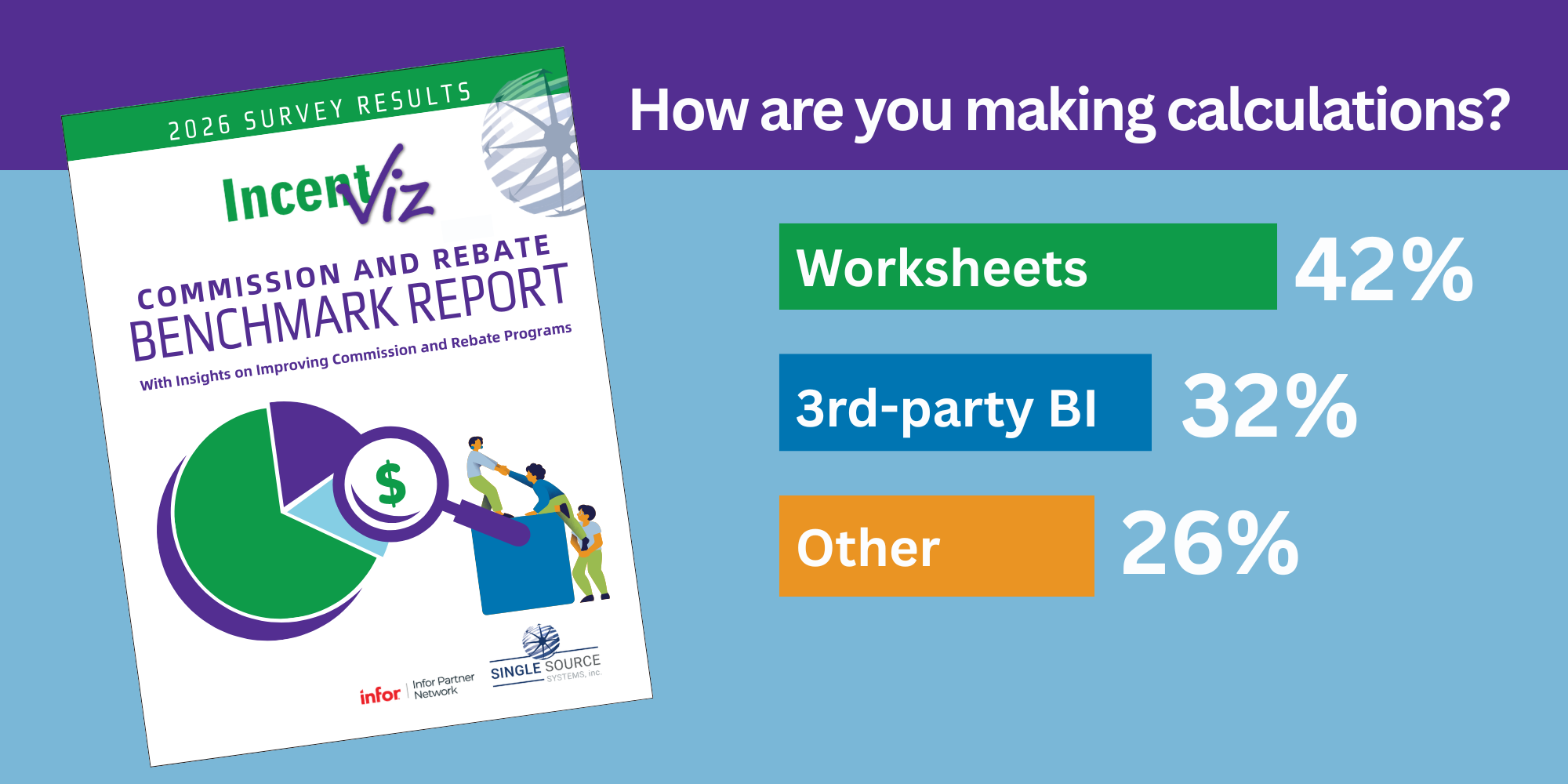
Ill-Suited Tools. The survey shows that 42% are exporting reports from their system then importing them into a worksheet tool, like Excel, to manipulate the data. The process of moving data between solutions opens doors for errors. This is how discrepancies are born. Lack of real-time visibility in the static reports hides errors.
Integration Issues. For 32% of respondents, third-party business intelligence (BI) tools are being used to extract information. Again, this process has flaws. Third-party tools can lack real-time, seamless integration needed to generate complex data analysis. BI logic that differs from the core business system logic will inevitably cause discrepancies. This lack of congruity causes stress points.
Make-shift Attempts. Other custom-built tools are used by 26% of respondents, indicating that over a quarter of the respondents opted for a make-shift solution, a solution possibly built by the in-house IT team, relying on apps cobbled together and expensive to maintain. Lacking specialized commission management features, this type of generic approach is limiting.
-2.png?width=1199&height=662&name=Single%20Source%20Systems%20-%20Final%20Logo%202019-01-color%20(002)-2.png "Single Source Systems - Final Logo 2019-01-color (002)-2")
-2.png?width=1449&height=800&name=Single%20Source%20Systems%20-%20Final%20Logo%202019-01-color%20(002)-2.png "Single Source Systems - Final Logo 2019-01-color (002)-2")